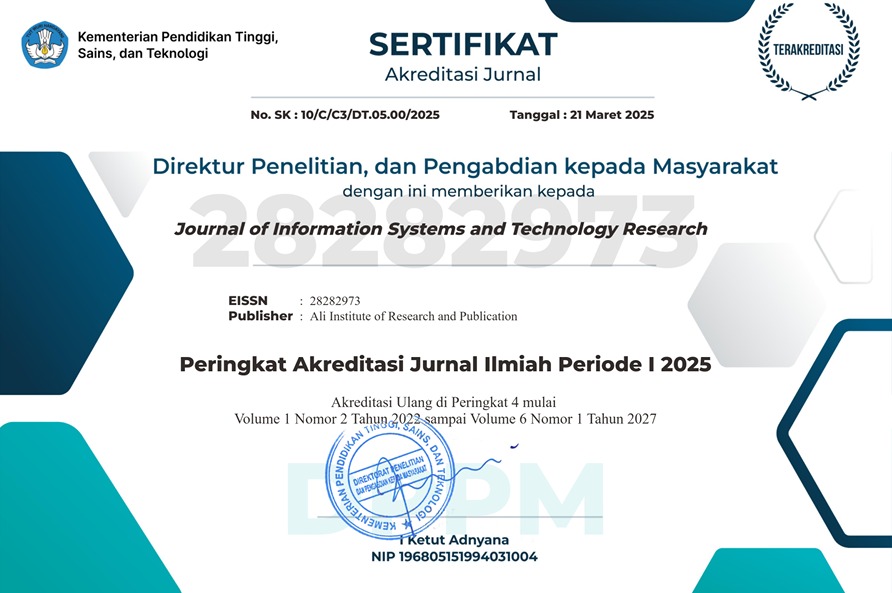
SINTA 4
NEW ACCREDITATION
JISTR is committed to maintaining academic integrity, originality, and ethical scholarly publishing. All submitted manuscripts must represent original scholarly work and appropriately acknowledge the intellectual contributions, ideas, data, methods, and publications of other researchers.
Plagiarism, improper citation, substantial unattributed text reuse, and duplicate publication are unacceptable. All manuscripts are subject to plagiarism screening using Turnitin as part of the journal's editorial quality assurance process.
Plagiarism occurs when an individual presents another person's words, ideas, data, research findings, or intellectual contributions as their own without appropriate acknowledgement.
The journal recognizes several forms of plagiarism and related publication misconduct:
The editorial team evaluates suspected plagiarism based on the nature, extent, and context of the overlap rather than relying solely on automated similarity percentages.
Authors must ensure that submitted manuscripts contain original scholarly contributions and that all sources used in preparing the research are accurately and appropriately acknowledged.
Authors are required to:
Proper citation does not automatically justify extensive reproduction of previously published material. Authors must ensure that their manuscripts demonstrate meaningful originality and comply with applicable copyright requirements.
JISTR uses Turnitin to evaluate textual similarity and identify potential overlap with published literature and other available sources.
The journal applies a maximum overall similarity threshold of 25% during the initial manuscript screening process.
| Similarity Result | Editorial Assessment |
|---|---|
| 25% or below | The manuscript may proceed to further editorial assessment, provided that no significant plagiarism or inappropriate textual overlap is identified. |
| Above 25% | The manuscript does not meet the journal's similarity threshold and may be returned for correction or rejected following editorial assessment. |
A Turnitin similarity score indicates textual overlap and does not independently establish plagiarism. The editorial team examines the similarity report by considering the matched sources, quotation practices, citations, and the context of overlapping material.
Similarity arising from correctly cited quotations, standard terminology, reference lists, or commonly used methodological expressions may require contextual evaluation. Such material does not automatically constitute plagiarism.
Conversely, a manuscript with a similarity score below 25% may still be considered problematic if it contains unattributed copying, inappropriate paraphrasing, or other evidence of plagiarism.
The editorial team retains responsibility for determining whether the manuscript meets the journal's originality and research integrity requirements.
Plagiarism screening is integrated into the manuscript evaluation process and may involve the following stages:
The editorial team may conduct additional similarity checks during subsequent manuscript revisions or before final publication when necessary.
Manuscripts are not automatically accepted or rejected solely on the basis of an automated similarity score. Editorial decisions consider the available evidence and the seriousness of any identified irregularities.
Authors must not submit the same manuscript simultaneously to multiple journals or present previously published research as an entirely new scholarly contribution.
Submissions must not have been previously published as journal articles or be under consideration by another journal at the time of submission.
An extended version of a conference paper may be considered when it contains substantial new scholarly contributions, appropriately cites the original publication, and clearly discloses the relationship between the previous and submitted versions.
The editorial team determines whether such submissions demonstrate sufficient originality and comply with the journal's publication ethics and manuscript requirements.
Authors must disclose relevant earlier versions of their research to avoid misleading claims of originality or duplicate publication.
The use of artificial intelligence (AI) or AI-assisted technologies does not exempt authors from their responsibilities concerning originality, appropriate citation, research integrity, and intellectual property rights.
Authors must verify AI-assisted content to ensure that it does not contain unattributed reproduced material, fabricated references, misleading citations, or other forms of academic misconduct.
AI-generated text is not automatically classified as plagiarism. Concerns regarding AI-assisted content must be assessed based on evidence of inappropriate attribution, research misconduct, or violations of the journal's disclosure requirements.
Detailed requirements regarding responsible AI use and disclosure are provided in the AI Use Policy .
When suspected plagiarism is identified, the editorial team evaluates the concern in accordance with the journal's publication ethics and research integrity procedures.
Depending on the nature and severity of the concern, editorial actions may include:
Authors should be given a reasonable opportunity to explain the identified concerns before a final determination of misconduct is made.
If significant plagiarism is identified after publication, the journal may initiate an investigation and consider appropriate corrective actions, including publication of a correction, expression of concern, or retraction.
Post-publication actions must follow the journal's established procedures for maintaining the integrity of the scholarly record.
This Plagiarism Policy should be read together with the following journal policies:
For information about the similarity-checking software, please visit the official Turnitin website .


|
Address
Jl. Pukat Banting IV No.41, Bantan,
Medan Tembung District, Medan City, North Sumatra 20223 |
Contact
Journal of Information Systems and Technology Research
✉ journal.jistr@gmail.com
☎ +6281263151592
|
Publisher
Ali Institute of Research and Publication (AIRA)
– Ali Bersaudara Sejahtera Foundation
|
License
 Creative Commons
CC BY-SA 4.0 |