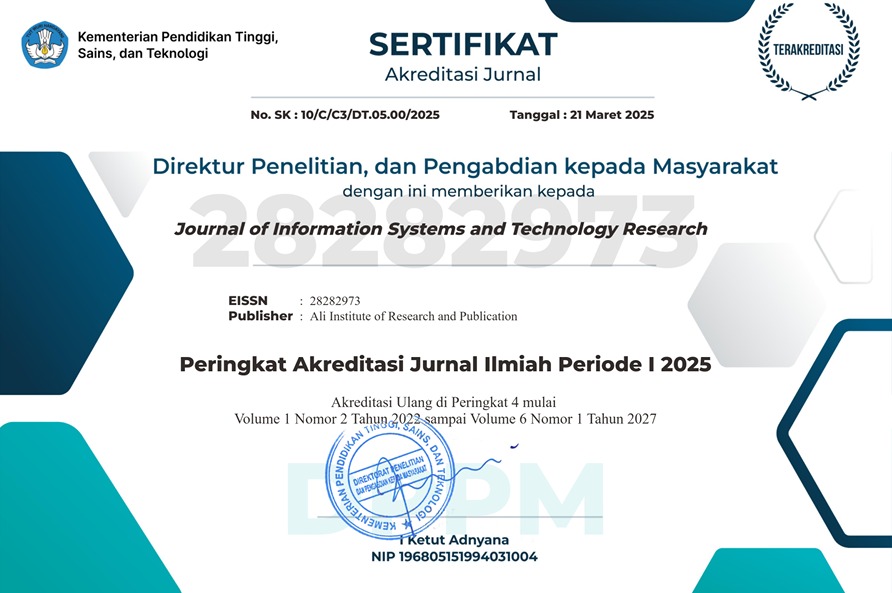
SINTA 4
NEW ACCREDITATION
JISTR is committed to maintaining high standards of publication ethics, research integrity, transparency, and responsible scholarly communication. The journal's ethical policies are informed by the principles and recommendations of the Committee on Publication Ethics (COPE) and internationally recognized standards of scholarly publishing.
All parties involved in the publication process, including authors, editors, reviewers, and the publisher, are expected to uphold ethical standards and maintain the integrity of the scholarly record. The journal does not tolerate plagiarism, research fabrication, falsification, duplicate publication, manipulation of the peer-review process, or other forms of publication misconduct.
Editors are responsible for ensuring that submitted manuscripts are evaluated fairly, objectively, and independently. Editorial decisions must be based on the scientific quality, originality, methodological rigor, and relevance of the research.
The Editor-in-Chief or an authorized handling editor makes the final editorial decision after considering reviewer evaluations and the journal's scientific and ethical standards.
Reviewers play an essential role in maintaining the scientific quality and integrity of published research. Reviewers must provide independent, objective, constructive, and evidence-based evaluations.
Reviewers must not disclose, distribute, or use confidential manuscript content without appropriate authorization. Detailed procedures are provided in the Peer Review Policy.
Authors are responsible for the originality, accuracy, transparency, and integrity of their submitted research. Manuscripts must present an accurate account of the research conducted, including the methods, data, results, and conclusions.
Authors are required to:
Authorship must reflect genuine intellectual contributions. Guest authorship, gift authorship, ghost authorship, and unauthorized changes to the authorship list are unacceptable.
All authors must approve the final manuscript and accept accountability for their contributions. Detailed authorship requirements are available in the Author Guidelines.
JISTR requires all submitted manuscripts to comply with recognized standards of academic honesty and research integrity. Plagiarism, self-plagiarism involving undisclosed substantial text reuse, inappropriate citation practices, data fabrication, data falsification, and redundant publication are considered unacceptable.
Manuscripts are subject to similarity screening using Turnitin. Similarity reports are evaluated by the editorial team with consideration of the nature of matched content, appropriate citations, and the context of textual overlap.
A similarity percentage alone does not establish whether plagiarism has occurred. The editorial team may request clarification, manuscript revision, or supporting documentation when potential irregularities are identified.
Detailed screening requirements are available in the Plagiarism Policy.
JISTR takes allegations of research and publication misconduct seriously, whether concerns arise before or after publication. Allegations may include plagiarism, data fabrication, data falsification, image manipulation, authorship misconduct, citation manipulation, peer-review manipulation, duplicate publication, or other practices that undermine the integrity of scholarly research.
Reports of suspected misconduct are handled through the following procedure:
Individuals involved in an allegation must be given a reasonable opportunity to respond before conclusions are reached. Allegations will be assessed fairly, confidentially where practicable, and without presuming misconduct before the available evidence has been evaluated.
Reports submitted anonymously may also be considered when they contain specific and verifiable evidence. The journal may refer matters requiring formal institutional investigation to the appropriate research institution.
A conflict of interest, also referred to as a competing interest, arises when financial, professional, institutional, personal, or other relationships could influence, or reasonably be perceived to influence, the conduct, evaluation, interpretation, or publication of research.
The following requirements apply:
When a conflict involving a handling editor is identified, the manuscript should be reassigned to an editor who is free from the relevant conflict. If a previously undisclosed competing interest is identified after publication, the journal may investigate and publish an appropriate disclosure or correction.
Authors must provide a conflict-of-interest declaration, including a statement when no competing interests exist.
Research involving human participants, personal information, sensitive datasets, or other ethically regulated materials must comply with applicable laws, institutional regulations, and recognized ethical standards.
Where applicable, authors must obtain approval from an appropriate ethics committee or institutional review board and secure informed consent from research participants. Relevant approval or consent information should be clearly reported in the manuscript.
Authors must take appropriate measures to protect confidential information, personal data, and the privacy of research participants. Data collection and processing must comply with applicable privacy and research ethics requirements.
Research findings should be supported by reliable and appropriately documented data. Authors may be requested to provide underlying research data or supporting materials for editorial verification, subject to ethical, legal, privacy, and confidentiality restrictions.
Authors should retain research records for a reasonable period and provide sufficient methodological information to support the transparency and reproducibility of their work.
JISTR recognizes the potential benefits of artificial intelligence (AI), generative AI, Large Language Models (LLMs), and AI-assisted technologies in scholarly research and publishing. The journal permits responsible and transparent use of these technologies by authors, subject to appropriate disclosure, human verification, academic integrity, and compliance with the journal's AI Use Policy.
AI Use by Authors: Authors may use AI-assisted technologies for legitimate research activities and manuscript preparation. Every submitted manuscript must include an AI Use Declaration, either identifying relevant AI-assisted technologies and their specific purposes or confirming that no AI-assisted technologies requiring disclosure were used. Authors remain fully responsible for the originality, accuracy, scientific validity, and integrity of their work. AI systems cannot be listed as authors or co-authors.
Prohibition of AI Use by Peer Reviewers: JISTR strictly prohibits peer reviewers from using AI, generative AI, Large Language Models, or AI-assisted technologies during the manuscript peer-review process. Reviewers must not use AI to analyze, summarize, evaluate, or interpret submitted manuscripts; assess scientific quality or originality; generate, draft, rewrite, or substantively edit peer-review reports; or determine or recommend editorial decisions.
Reviewers are strictly prohibited from uploading, copying, pasting, or otherwise entering submitted manuscripts, manuscript excerpts, supplementary materials, unpublished research data, or confidential review information into AI applications or services. This prohibition applies throughout the peer-review process and cannot be waived through authorization from editors or authors. All peer-review assessments must be conducted independently by qualified human reviewers.
AI Use by Editors and Editorial Staff: Editors and editorial staff may use AI-assisted technologies only for appropriate administrative or publishing activities that do not compromise confidentiality, data protection, scientific integrity, or editorial independence. Such activities must not involve unauthorized disclosure of confidential manuscripts, peer-review reports, unpublished research materials, or protected editorial communications.
AI must not replace independent scientific evaluation, independently assess the substantive merit of manuscripts, or determine editorial decisions concerning manuscript acceptance, revision, or rejection. Final editorial decisions remain the responsibility of the Editor-in-Chief or an authorized handling editor.
Editors and editorial staff must disclose relevant AI-assisted technologies used in permitted editorial or production-related activities to the Editor-in-Chief or an authorized editorial representative. Such disclosures must be appropriately documented in the journal's internal editorial records.
Research Integrity and Accountability: AI-assisted technologies must not be used to fabricate research data, falsify findings, generate fictitious references, manipulate scientific evidence, conceal plagiarism, or otherwise compromise research integrity. All parties remain accountable for their respective scholarly and editorial responsibilities.
Verification and Editorial Assessment: Concerns involving undisclosed AI use, prohibited reviewer AI use, breaches of confidentiality, fabricated references, manipulated research content, or other inappropriate applications of AI will be evaluated in accordance with the journal's research misconduct procedures. Automated AI-content detection results must not be treated as conclusive evidence of misconduct without appropriate human assessment and consideration of the available evidence.
Suspected violations may result in appropriate corrective or editorial action following a fair assessment. Affected parties must be given a reasonable opportunity to provide explanations and supporting evidence before final determinations are made.
Detailed requirements for authors, reviewers, editors, and editorial staff are provided in the AI Use Policy and Peer Review Policy.
JISTR provides a mechanism for authors, reviewers, readers, and other stakeholders to raise concerns about editorial decisions, publication procedures, ethical conduct, or the handling of submitted and published manuscripts.
Complaints and appeals should be submitted through the journal's official contact information and should include a clear explanation of the concern, relevant manuscript or article details, and any supporting evidence.
Appeals against editorial decisions must provide substantive grounds, such as a demonstrable factual error, procedural irregularity, or significant misunderstanding of the manuscript's scientific content.
Complaints are reviewed by the Editor-in-Chief or an appropriate independent editorial representative when a conflict of interest exists. Matters concerning the conduct of the Editor-in-Chief may be referred to the publisher or another uninvolved representative.
The journal evaluates complaints objectively and communicates the outcome to the complainant where appropriate. An appeal does not automatically reverse an editorial decision.
JISTR recognizes post-publication scholarly discussion as an important mechanism for strengthening scientific knowledge, addressing alternative interpretations, and maintaining the accuracy of the published literature.
Authors, readers, and researchers may submit evidence-based comments, scientific criticisms, methodological concerns, or requests for clarification regarding published articles through the journal's official contact channel.
Submitted comments should identify the relevant article and provide a clear scientific explanation supported by appropriate evidence or references. Personal attacks, defamatory statements, and unsupported allegations are not acceptable.
The editorial team evaluates post-publication comments for relevance, accuracy, scholarly value, and compliance with publication ethics. When appropriate, the journal may invite the original authors to provide a response and may publish or link relevant scholarly commentary and responses.
Where a discussion identifies a potential error or ethical concern affecting the published record, the matter will be evaluated under the journal's correction and retraction procedures.
Post-publication inquiries and discussion submissions may be directed through the Contact Information page.
JISTR is committed to maintaining the reliability and accuracy of its published scholarly record. When errors, ethical violations, or significant concerns are identified after publication, the journal may take appropriate corrective action in accordance with recognized publication ethics principles.
A correction may be issued when a published article contains an error that requires clarification or amendment but does not invalidate the overall reliability of the research findings or conclusions.
Corrections should clearly identify the original article, describe the error and the necessary amendment, and maintain a transparent connection to the published record.
Retraction may be considered when a published article contains serious errors, unreliable findings, substantial plagiarism, fabricated or falsified data, compromised peer review, unethical research practices, or other significant concerns that undermine confidence in the article.
A retraction decision is made by the Editor-in-Chief or an authorized independent editor after an appropriate assessment of the available evidence and consultation with relevant parties where necessary.
Retraction notices must identify the affected article, explain the reason for retraction, and remain publicly accessible. The retracted article should ordinarily remain available as part of the scholarly record with a clear indication of its retracted status.
Retraction is intended to correct the scholarly literature and protect research integrity rather than to punish authors.
An expression of concern may be published when substantial questions arise regarding a published article but the available evidence is inconclusive, an investigation is ongoing, or the matter cannot yet be fully resolved.
An expression of concern should clearly identify the article involved and explain the nature of the unresolved concern without presenting unverified allegations as established facts.
Authors are expected to promptly notify the editorial office if they discover significant errors or inaccuracies in their published work and cooperate in determining an appropriate corrective action.
The journal may issue corrections, retraction notices, or expressions of concern as necessary to maintain the integrity of the published record. Relevant notices should be clearly identified and linked to the affected article where technically possible.
Further information on manuscript preparation, peer review, plagiarism prevention, and editorial requirements is available through the following journal policies:
For additional guidance on responsible scholarly publishing, please refer to the Committee on Publication Ethics (COPE) and its published guidance on publication ethics and research integrity.


|
Address
Jl. Pukat Banting IV No.41, Bantan,
Medan Tembung District, Medan City, North Sumatra 20223 |
Contact
Journal of Information Systems and Technology Research
✉ journal.jistr@gmail.com
☎ +6281263151592
|
Publisher
Ali Institute of Research and Publication (AIRA)
– Ali Bersaudara Sejahtera Foundation
|
License
 Creative Commons
CC BY-SA 4.0 |