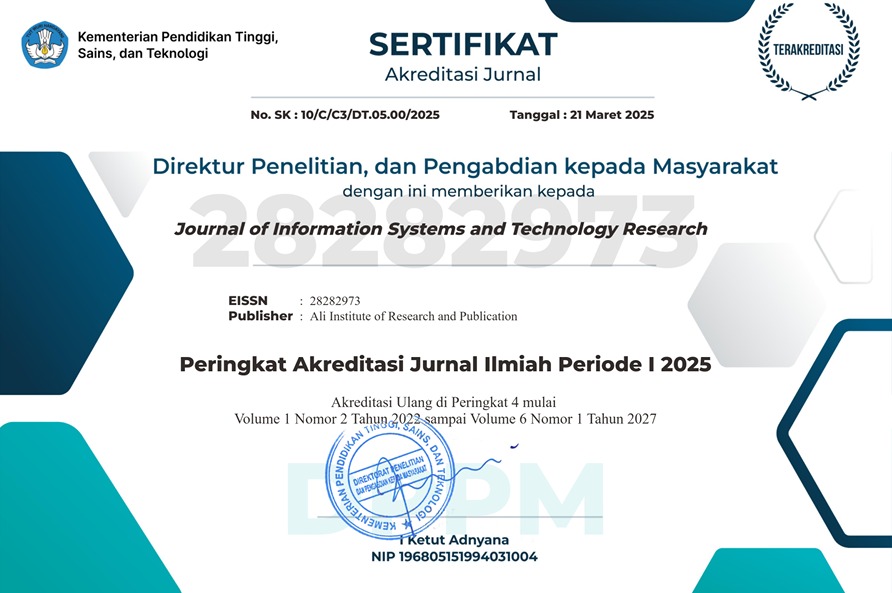
SINTA 4
NEW ACCREDITATION
JISTR applies a double-blind peer-review system to ensure the quality, originality, scientific validity, and relevance of submitted manuscripts. Under this system, the identities of authors and reviewers are concealed from one another throughout the review process.
Each manuscript that passes the initial editorial screening is evaluated by at least two reviewers with expertise relevant to the manuscript's subject area. Editorial decisions are made based on scientific merit, reviewer recommendations, and compliance with the journal's editorial policies.
All submitted manuscripts undergo an initial assessment by the editorial team before being considered for external peer review. The screening includes:
The similarity report is assessed by the editor, taking into account the nature of the matched content, citation practices, and possible textual overlap. A similarity percentage alone does not constitute definitive evidence of plagiarism.
Manuscripts that do not meet the journal's initial requirements may be returned for correction or rejected without proceeding to external peer review (desk rejection).
Manuscripts that successfully pass the initial screening are assigned to at least two qualified reviewers. The review process follows a double-blind procedure in which reviewers do not receive the authors' identities and authors are not informed of the reviewers' identities.
The editor may appoint additional reviewers when further expert evaluation is required, when reviewer recommendations differ substantially, or when an additional assessment is necessary to support an editorial decision.
Authors are responsible for preparing anonymized manuscripts in accordance with the journal's submission guidelines. The editorial team may request the removal of identifying information before the manuscript is forwarded for review.
Reviewers are selected based on their academic expertise, research experience, and relevance to the subject of the submitted manuscript. The editorial team is responsible for coordinating reviewer assignments and maintaining the integrity of the review process.
Reviewers are expected to:
Reviewers must not use unpublished information obtained during peer review for personal research or other purposes without appropriate authorization.
The prohibition on AI use during peer review is further explained in Section 9 of this policy and in the journal's AI Use Policy.
Reviewers evaluate manuscripts according to the following scientific criteria:
Following peer review, the editor evaluates the reviewers' comments and recommendations before determining the appropriate editorial decision.
Possible editorial decisions include:
Authors receiving revision requests are expected to address reviewers' comments carefully and provide a revised manuscript accompanied by a clear explanation of the changes made.
Revised manuscripts may be returned to the original reviewers or evaluated further by the editor when necessary. Additional revision rounds may be requested before a final decision is reached.
The final decision on manuscript acceptance or rejection rests with the Editor-in-Chief or an authorized handling editor. Reviewer recommendations inform the editorial decision but do not independently determine acceptance.
The peer-review process generally requires at least one month after a reviewer accepts an invitation. However, the actual duration may vary depending on manuscript quality, reviewer availability, revision requirements, and the number of review rounds.
The editorial team monitors the review process and communicates relevant decisions and revision requests to authors through the journal's online submission system.
Review duration estimates do not constitute a guarantee of manuscript acceptance or a fixed publication date.
Manuscripts that receive final editorial acceptance proceed to the production stage, which includes copyediting, layout preparation, and proofreading.
Copyediting: Accepted manuscripts are reviewed for language clarity, grammar, terminology, consistency, and compliance with the journal's publication format. Authors may be asked to review copyedited manuscripts and clarify necessary corrections.
Layout: The manuscript is prepared in the journal's official publication format, including the arrangement of text, tables, figures, references, and other document elements.
Proofreading: The final proof is provided to the author for checking typographical, formatting, and production errors. Authors are expected to return necessary corrections before final publication.
After completion of the production process, the article is assigned to the appropriate volume and issue in accordance with the journal's publication schedule.
All submitted manuscripts and related review materials are treated as confidential documents. Editors and reviewers are required to protect unpublished information and prevent unauthorized disclosure or misuse.
Editorial decisions must be based on scientific quality, originality, methodological rigor, and relevance to the journal's scope. Financial considerations, personal relationships, or other inappropriate influences must not determine editorial outcomes.
Any potential conflict of interest involving an editor or reviewer must be disclosed and appropriately managed to maintain the independence and credibility of the peer-review process.
JISTR maintains a clear distinction between the responsibilities of peer reviewers and editorial personnel regarding artificial intelligence (AI) and AI-assisted technologies. The journal prohibits the use of AI by reviewers during the peer-review process and establishes restrictions on AI use by editors to protect confidentiality, research integrity, and editorial independence.
Peer reviewers are strictly prohibited from using AI, generative AI, Large Language Models, or AI-assisted technologies in the evaluation of submitted manuscripts.
This prohibition includes, but is not limited to:
The prohibition applies throughout the peer-review process and cannot be waived through individual authorization from the editorial team.
Reviewers must independently examine manuscripts, prepare their own scientific evaluations, and provide recommendations based on their professional expertise and scholarly judgment.
Editors and editorial staff may use AI-assisted technologies only for permitted administrative or publishing activities that do not compromise confidentiality, data protection, scientific integrity, or editorial independence.
AI must not replace scientific assessment or be used to make editorial decisions concerning manuscript acceptance, revision, or rejection. Confidential manuscripts, reviewer reports, unpublished research materials, and protected editorial communications must not be disclosed to unauthorized AI systems.
Any permitted use of AI by editors or editorial staff must be appropriately disclosed to the Editor-in-Chief or authorized editorial representative, including the tool used, its purpose, and the safeguards applied to protect confidential information.
All editorial decisions remain the responsibility of the Editor-in-Chief or an authorized handling editor.
Detailed requirements concerning the prohibition of AI use by reviewers, permitted and restricted AI use by editors, disclosure obligations, and confidentiality safeguards are provided in the AI Use Policy .
Manuscript submission, reviewer assignment, editorial communication, revision requests, and editorial decisions are managed through the JISTR Open Journal Systems (OJS) platform.
Authors are encouraged to monitor their manuscript status through their registered OJS accounts and respond to editorial requests within the specified deadlines.
Additional information regarding manuscript preparation, ethical standards, and publication requirements is available through the following policies:


|
Address
Jl. Pukat Banting IV No.41, Bantan,
Medan Tembung District, Medan City, North Sumatra 20223 |
Contact
Journal of Information Systems and Technology Research
✉ journal.jistr@gmail.com
☎ +6281263151592
|
Publisher
Ali Institute of Research and Publication (AIRA)
– Ali Bersaudara Sejahtera Foundation
|
License
 Creative Commons
CC BY-SA 4.0 |