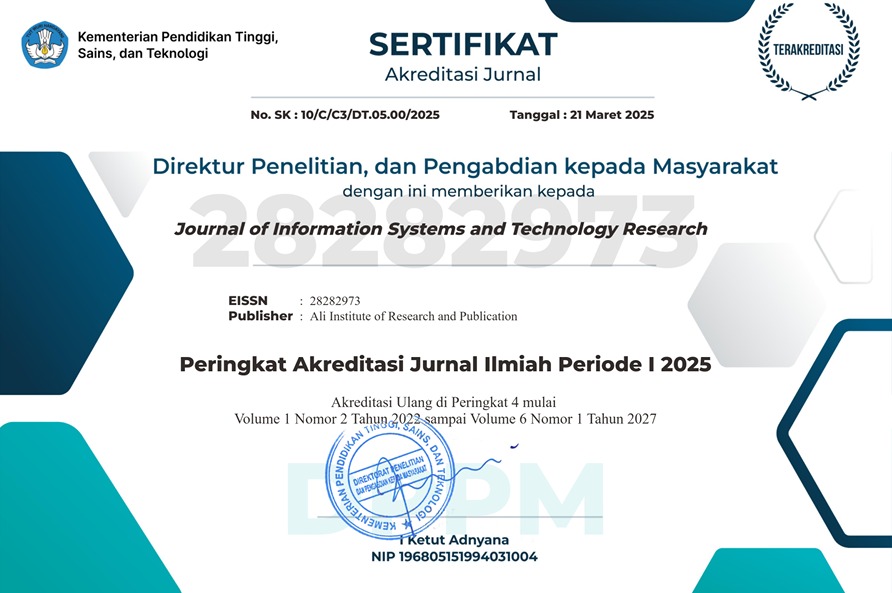
SINTA 4
NEW ACCREDITATION
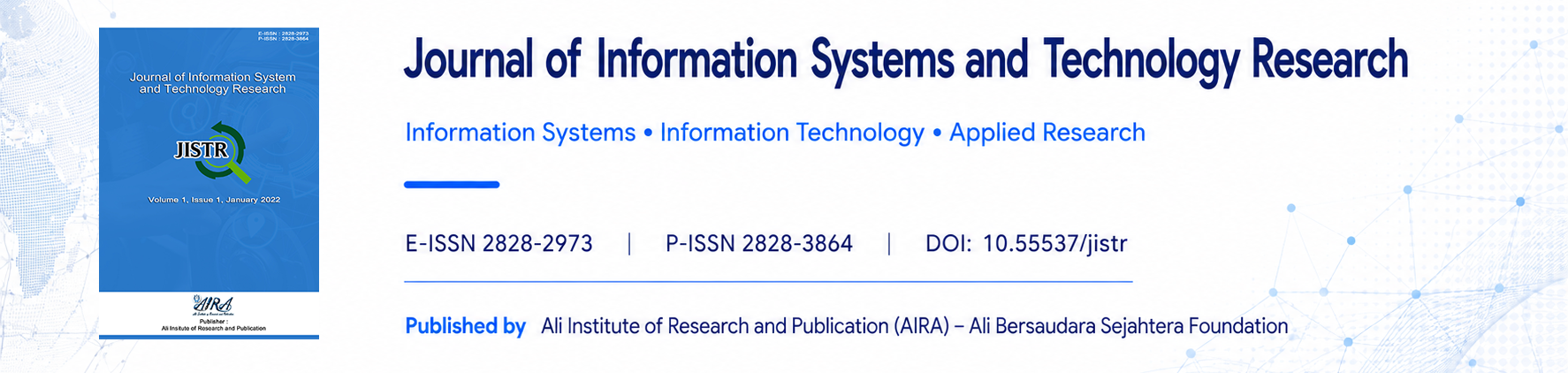
JISTR recognizes the growing role of Artificial Intelligence (AI), generative AI, Large Language Models (LLMs), and AI-assisted technologies in scientific research and scholarly publishing. The journal supports the responsible and transparent use of these technologies while maintaining academic integrity, originality, accountability, confidentiality, and ethical scholarly communication.
This policy establishes requirements for authors, reviewers, editors, and other parties involved in the publication process. It is informed by the Committee on Publication Ethics (COPE), the International Committee of Medical Journal Editors (ICMJE), and the requirements of the Indonesian Scientific Journal Accreditation Technical Guidelines established under Director General of Science and Technology Decree No. 374/DST/D.D1/HM.01.01/2026.
The use of AI-assisted technologies in scholarly publishing must comply with the following principles:
Authors may use AI-assisted technologies to support legitimate research activities and manuscript preparation, provided that such use is scientifically appropriate, transparent, properly documented, and subject to human verification.
Permitted applications may include:
All AI-assisted outputs must be critically reviewed and verified by the authors. AI-generated suggestions must not be accepted as scientifically valid without independent evaluation.
Authors must verify the accuracy of factual claims, references, citations, datasets, computational outputs, and interpretations produced with AI assistance. The use of AI does not remove the authors' responsibility for the originality, validity, reproducibility, or ethical compliance of their research.
Routine use of conventional spelling and grammar-checking functions that do not generate substantive scholarly content does not generally require a separate declaration. However, the use of generative AI for manuscript writing, substantive editing, translation, literature synthesis, programming, data analysis, interpretation, or research content must be disclosed.
Authors must transparently disclose the use of generative AI or AI-assisted technologies that have contributed to manuscript preparation, research methodology, scientific analysis, interpretation, or the generation of scholarly content.
Each submitted manuscript must include an AI Use Declaration identifying relevant AI assistance or confirming that no AI-assisted technologies requiring disclosure were used.
When AI-assisted technologies are used, the declaration must include:
AI assistance involving writing, language editing, translation, or preparation of manuscript content must be identified in an appropriate declaration section. Where AI is used as part of the research methodology, including computational modeling, data analysis, code generation, or image generation, the relevant methods and procedures must also be described with sufficient detail to support transparency and reproducibility.
AI Use Declaration: During the preparation of this manuscript, the authors used [AI Tool Name, Provider, and Version] for [specific purpose and extent of use]. All AI-assisted outputs were independently reviewed, verified, and edited by the authors. The authors take full responsibility for the accuracy, originality, validity, and integrity of the manuscript.
AI Use Declaration: The authors declare that no generative AI or AI-assisted technologies requiring disclosure under the journal's AI Use Policy were used in the preparation of this manuscript.
Failure to disclose AI assistance when required may be treated as a violation of the journal's publication ethics requirements and may result in editorial review or corrective action.
Artificial Intelligence systems, including generative AI applications, chatbots, and Large Language Models, cannot be listed as authors or co-authors of scientific manuscripts.
Authorship requires intellectual accountability, approval of the final manuscript, responsibility for the integrity of the research, and the ability to respond to questions concerning the published work. AI systems cannot fulfill these responsibilities.
All listed human authors remain fully responsible for the accuracy, originality, scientific validity, ethical compliance, and integrity of the submitted manuscript, including any material developed with AI assistance.
AI-generated responses must not be cited as substitutes for verifiable scholarly references. Authors must consult and cite original academic sources when supporting scientific claims.
JISTR prohibits the use of AI-assisted technologies for activities that compromise research integrity, academic honesty, intellectual property rights, or the reliability of scientific publications.
Prohibited practices include:
The use of AI-generated images, synthetic data, or computationally generated research materials must be scientifically justified, transparently reported, and appropriately distinguished from authentic observational or experimental data.
When AI-generated or synthetic materials form part of the research methodology, authors must explain their generation, validation, limitations, and role in the study.
JISTR strictly prohibits peer reviewers from using artificial intelligence (AI), generative AI, Large Language Models, or AI-assisted technologies in the manuscript peer-review process.
This prohibition protects the confidentiality of unpublished research and ensures that peer-review evaluations are based on the independent scientific expertise, critical analysis, and professional judgment of qualified human reviewers.
Reviewers are specifically prohibited from using AI to:
The prohibition applies throughout the peer-review process and cannot be waived through individual authorization from an editor or permission from an author.
Reviewers must personally read and evaluate assigned manuscripts, prepare their own review comments, and formulate recommendations using their independent scholarly judgment.
Reviewers must maintain the confidentiality of all unpublished manuscripts and editorial communications and must not use manuscript information for unauthorized purposes.
If a reviewer requires assistance that would involve AI processing of manuscript content or review comments, the reviewer must not proceed with such use and should contact the handling editor for an alternative arrangement that complies with this policy.
Any suspected violation of this prohibition may result in termination of the review assignment, exclusion from future reviewer invitations, or other appropriate action following editorial assessment.
Editors and editorial staff may use AI-assisted technologies only for appropriate administrative or publishing activities that do not compromise manuscript confidentiality, data protection, editorial independence, or research integrity.
Subject to appropriate safeguards and editorial authorization, limited uses may include:
Editors and editorial staff must not upload confidential manuscripts, peer-review reports, author identities, unpublished research materials, or editorial correspondence into unauthorized AI systems.
AI must not be used to replace scientific evaluation, assess the substantive merit of manuscripts independently, or make decisions concerning manuscript acceptance, revision, or rejection.
Editorial assessments and final decisions must remain the responsibility of the Editor-in-Chief or an authorized handling editor.
Editors and editorial staff must disclose any AI-assisted technology used in their editorial or production-related activities to the Editor-in-Chief or an authorized editorial representative.
The disclosure should document:
Such disclosures should be documented in the journal's internal editorial records. Where appropriate, relevant AI assistance should also be disclosed to affected parties.
The use of AI does not diminish the individual responsibility of editors for confidentiality, impartiality, manuscript evaluation, or editorial decisions.
All permitted users of AI-assisted technologies must respect applicable data protection requirements, research confidentiality obligations, copyright regulations, and intellectual property rights.
Authors must not submit confidential research data, protected personal information, or restricted institutional materials to AI services without appropriate authorization and suitable safeguards.
Editors and editorial staff must protect confidential manuscripts and editorial information and must comply with the restrictions established in Section 7 of this policy.
Reviewers are subject to the prohibition established in Section 6 and must not upload or process confidential manuscript materials using AI during peer review.
Authors are responsible for ensuring that AI-assisted content does not improperly reproduce copyrighted material, disclose sensitive information, or violate the rights of third parties.
The use of an AI tool does not remove the responsibility to obtain required permissions, provide appropriate acknowledgements, and comply with applicable legal and ethical requirements.
The editorial team may examine concerns related to undisclosed AI use, fabricated references, manipulated research materials, unreliable AI-generated content, prohibited reviewer AI use, or other potential violations of publication ethics.
Automated AI-content detection tools may be used by authorized editorial personnel as supplementary screening instruments where appropriate and consistent with confidentiality and data protection requirements. Such tools must not replace independent human assessment.
Automated AI detection results must not be considered conclusive evidence of AI misuse or research misconduct because these tools may produce inaccurate or misleading classifications.
Editorial assessments must consider the available evidence, the nature of the suspected violation, manuscript context, author explanations, and the limitations of automated detection technologies.
The editorial team may request clarification, documentation, research data, or additional information when concerns regarding AI-assisted content require further examination.
Failure to comply with this policy may result in editorial action depending on the nature, severity, and potential consequences of the violation.
Possible actions include:
Suspected violations are assessed in accordance with the journal's Publication Ethics and Research Integrity policy. Authors, reviewers, editors, and other affected parties should be given a reasonable opportunity to provide explanations and supporting evidence before final determinations are made.
The objective of editorial action is to protect the reliability of the scholarly record, promote transparency, and maintain public trust in scientific publishing.
This AI Use Policy should be read in conjunction with the following journal policies:
This policy is informed by applicable Indonesian scientific journal accreditation requirements and internationally recognized guidance on responsible AI use in scholarly publishing.


|
Address
Jl. Pukat Banting IV No.41, Bantan,
Medan Tembung District, Medan City, North Sumatra 20223 |
Contact
Journal of Information Systems and Technology Research
✉ journal.jistr@gmail.com
☎ +6281263151592
|
Publisher
Ali Institute of Research and Publication (AIRA)
– Ali Bersaudara Sejahtera Foundation
|
License
 Creative Commons
CC BY-SA 4.0 |